
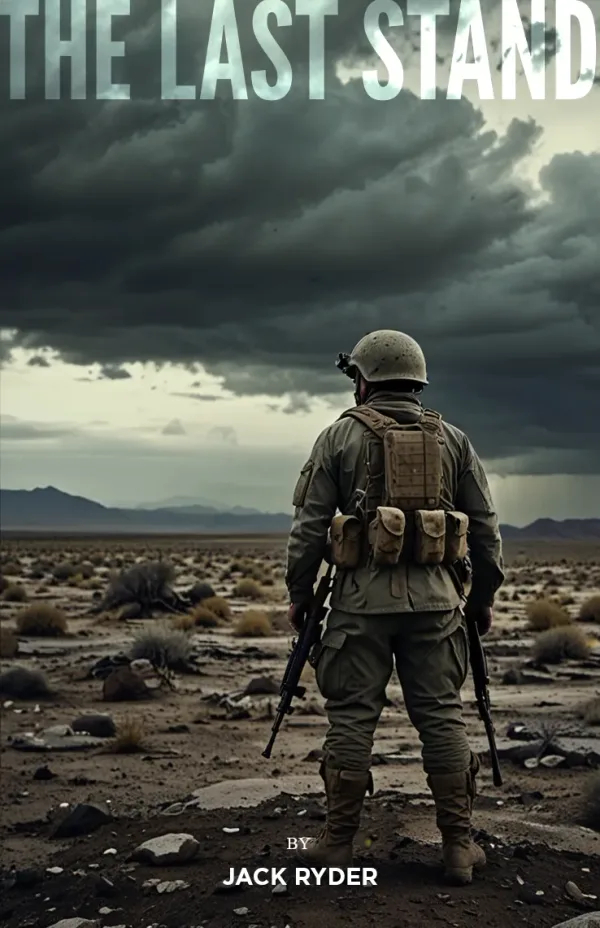
The Last Stand
by Jack Ryder
Storyline
Sergeant Daniels, trapped in a brutal war with his unit decimated and reinforcements absent, must rely on sheer grit to survive. Facing a relentless enemy, every decision is a life-or-death gamble. As the bonds of brotherhood are tested and the chaos of battle pushes soldiers to their limits, The Last Stand unfolds as a gritty tale of sacrifice, courage, and the harrowing cost of war. Will Daniels and his men endure, or will they be lost to the chaos?
Chapter One: The Edge of War
The sun was a distant memory as the sky above seemed to burn with an angry red hue, casting long shadows over the barren landscape. The fields once filled with lush crops were now scorched, craters from artillery shells and tank treads cutting jagged scars through the earth. The scent of smoke and death hung heavy in the air, choking the breath from any who dared to inhale deeply.
Sergeant Tom Daniels stood at the edge of the trench, his helmet low over his brow, his eyes squinting against the wind that swept through the battlefield. His face was smeared with dirt and blood—some of it his, but most of it was from the men who had come before him. The men who were now nothing more than memories, their bodies swallowed by the very ground they had fought to protect.
“Another day, Sergeant.” Corporal Harris’s voice came from behind him, thick with fatigue. Harris was a young man, barely old enough to grow a full beard, yet here he was, just another face among the dead and dying. His uniform was in tatters, his boots caked in mud and blood, but his eyes were sharp—too sharp for someone who had seen so much death.
Daniels didn’t answer right away. Instead, he surveyed the horizon, his hand gripping the edge of the trench. The artillery fire had slowed in recent hours, but the silence was a false one—nothing more than the calm before the storm. The enemy had been regrouping for days. Daniels knew what was coming next. A push. A breakthrough. Maybe this time, they’d be the ones to push back.
But even the thought of victory seemed hollow. No matter how many times they drove the enemy back, they kept coming. The war had become an endless cycle, and the survivors—those who still had breath in their lungs—were nothing more than pieces on a board, moved around by forces they couldn’t understand.
“They’ll be here soon,” Daniels muttered, his voice rough and tired. The words were meant for Harris, but his thoughts were already elsewhere, traveling back to the first day of the war, when the world seemed whole and his mind had been naive to what it would become.
Corporal Harris gave a small nod, tightening his grip on the rifle slung over his shoulder. The tension between them was palpable, a shared understanding that the war, for all its confusion and chaos, was as much about survival as it was about anything else.
The distant thud of mortar fire rumbled through the earth, shaking the trench walls. A few men jumped, but Daniels didn’t flinch. They’d all grown used to it by now—the sound of war echoing through their bones like a constant reminder that they were alive, but not truly living.
“How long you think we can hold this line?” Harris asked, his voice low.
Daniels didn’t answer immediately. He couldn’t afford to lie. “As long as we have to,” he said at last. “No more, no less.”
Harris seemed to consider that, his face etched with the weight of all the unspoken thoughts between them. They both knew the truth—the line was only holding because they had no choice. It wasn’t about courage anymore. It wasn’t about honor. It was about survival, and the knowledge that the moment they let their guard down, it would all be over.
The low hum of a distant engine cut through the air, and Daniels turned sharply, his eyes narrowing. The ground seemed to vibrate with the sound, growing louder by the second. They were here.
“They’re coming,” Daniels said, his voice a sharp whisper now, as if speaking too loudly would summon the enemy in some cursed way. He turned and motioned to the men below. “Positions!”
In a blur of motion, the soldiers of the 5th Battalion scrambled to their posts, some of them barely moving with the urgency of their training, others slower, their bodies stiff with fatigue. Daniels watched as the men fell into line, positioning themselves behind the sandbags, crouched low and waiting.
Harris appeared at his side, checking the clip in his rifle. “How many you think they’ve got?”
Daniels looked out toward the horizon, his gaze piercing through the haze of smoke and dust that lingered in the air. A line of black dots appeared, moving fast across the terrain—enemy soldiers advancing in formation, their figures stark against the twilight sky. Their numbers seemed endless, a sea of bodies, each one marching toward the inevitable.
“I don’t know,” Daniels said, his voice steady but low. “But we’ve held them back before. We’ll hold them back again.”
Harris glanced at him, his eyes dark with unspoken doubt, but he didn’t speak. The men knew. They all knew that holding the line had become less about strategy and more about sheer willpower. Every time they repelled the enemy, it was another day they bought in an unwinnable war.
The enemy’s artillery fire began again, the shells landing with a deafening roar. The trench shook as earth and metal exploded around them. Daniels crouched low, feeling the heat of the blast wash over him. For a moment, everything was just noise and chaos—a blur of dust and shrapnel. His heartbeat thudded in his chest, and he gripped his rifle tightly, the cold steel cutting into his palm.
The world was spinning, the noise deafening, but Daniels didn’t flinch. He couldn’t afford to. If he let fear take over now, if he showed weakness in front of the men, they would fall apart. They would all fall apart.
“Get ready!” Daniels shouted over the noise. The soldiers around him braced themselves. There was no turning back now. The enemy was closing in fast.
Chapter Two: Into the Inferno
The day bled into twilight, but there was no peace to be found. The trenches were now filled with the smell of gunpowder, blood, and the acrid stench of fear. Sergeant Daniels crouched low behind the sandbags, his rifle at the ready, his mind fully alert as the enemy approached. His eyes were locked on the horizon, watching the dust trail left by the advancing enemy troops. A battalion was coming at them, and they had no time left for doubt.
The ground trembled as artillery shells exploded close by. Daniels’ heart beat in sync with each blast. He had long since grown accustomed to the sound of war, the deafening explosions, the screams, the screams of men, but every time a shell hit, it felt as though it cracked him open a little more.
“Stay focused,” he muttered to himself, pushing the doubt to the back of his mind.
The soldiers around him moved in synchronized chaos, every man slipping into position like clockwork. The fire of an incoming artillery shell whizzed over his head, followed by a low groan of the earth being torn apart. A few men ducked for cover, their faces a mix of instinct and terror.
“Hold the line,” Daniels barked to them, his voice hard and commanding, a wall of authority that held back his own panic.
Corporal Harris, ever the obedient soldier, moved to his side. His eyes flicked nervously to the horizon, but he kept his gun steady. “How long, Sergeant?” Harris asked, a tremor in his voice.
“As long as we can,” Daniels answered, his gaze hardening. “You know the drill. Keep your head down. Watch your ammo. They’re coming, and this time, they’re not stopping.”
The men exchanged quick, uneasy glances. The unspoken question hung in the air: How long could they keep fighting before the inevitable broke through? Daniels had seen it before—the slow, crushing inevitability of defeat creeping up when all the hope had been drained out.
The first wave hit like a storm, as expected. The enemy soldiers charged across the fields, their uniforms soaked in dust and sweat, their weapons raised high. It wasn’t an organized assault, but a surge of bodies—horrific in its desperation. The sound of machine guns rang out in the air, slicing through the night, the sharp bursts deafening.
Daniels fired first, taking down a soldier as he stepped into view. His body fell, lifeless, to the ground. The others followed in a blur, instinct and training taking over. The rifle kicked back against Daniels’ shoulder with each shot. His breath came in shallow bursts, his hands steady despite the chaos.
“Keep firing!” Daniels shouted as the noise swirled around him like a hurricane. A moment of confusion on the battlefield—the men scattered like rats, trying to find cover from the hail of bullets.
But in the midst of it all, Daniels knew that they couldn’t last forever. They were outnumbered. The enemy’s tactics were well-coordinated, their infantry relentless. As the fighting pressed on, it became clear that the line was starting to crumble. Soldiers were dropping, their bodies piling up like discarded dolls. The cries of the wounded pierced the air, but there was no time for mercy.
“Keep them off the line! Keep them off the line!” Daniels yelled, his voice hoarse with the weight of his orders. He moved quickly between the men, guiding them to positions that would hold as long as they could.
The air crackled with gunfire, and the sound of explosions made the earth shake beneath their feet. For a brief moment, Daniels couldn’t hear anything other than the pounding in his ears. His heartbeat quickened, his adrenaline spiking.
Then, out of the smoke, they appeared: tanks. Massive metal beasts, rolling toward them, their cannons trained on the trench line. The men shrank back instinctively, their hands shaking, eyes wide. The tanks were a wall of unstoppable force.
“Get back!” Daniels shouted, pushing Harris out of the way as the first tank’s cannon fired. The explosion was deafening, sending a shockwave through the trench. Dirt and shrapnel flew through the air, tearing into the men around them. Daniels hit the ground, feeling the sting of the blast rip through his skin.
“Sergeant!” Harris shouted, his voice frantic. Daniels lifted his head, his vision blurred by the ringing in his ears, but he saw the look in Harris’ eyes. Fear.
The soldiers were scrambling now, scattering like ants, trying to avoid the fire from the tanks. But Daniels could see it in their eyes. They were trapped. The line was breaking, and they had no way to stop it.
Then, as if in slow motion, the moment of truth arrived.
The enemy soldiers began charging the trench, guns raised, their faces contorted in anger and fear. They were only yards away now, and the reality of what was coming set in. Daniels’ hand tightened around his rifle, but his mind wasn’t on the weapon anymore—it was on the men who had fought beside him. On the sacrifices made. On the promises of victory that felt like lies now.
“Hold the line!” Daniels screamed again, but his voice was drowned out by the sound of tanks rolling closer, the thunderous booms of artillery fire.
The enemy was upon them.
The trench erupted into chaos. The men fought with everything they had left, but the sheer weight of the enemy’s numbers overwhelmed them. Daniels fired round after round, but the enemy just kept coming. One by one, his men fell—some killed outright, others maimed, their screams reverberating in the air. Daniels could hear them, but he couldn’t afford to turn his head. He had to fight. He had to survive.
Through the fog of battle, Daniels found Harris again. The young corporal was slumped against the trench wall, his rifle still clutched in his hands, but his face was pale, his breath ragged.
“We need to fall back,” Harris said, barely able to speak over the chaos.
Daniels shook his head. “No,” he said, gritting his teeth. “We hold. We hold as long as we can.”
But the words felt hollow as he said them. The line was crumbling. The tank fire was relentless. The enemy’s charge was unstoppable.
And yet, Daniels fought on. He had no other choice.
The battle raged on around them—violent, brutal, unrelenting.
Chapter Three: The Last Stand
The night had descended upon the battlefield, but the darkness offered no relief. The air was thick with the acrid smoke of burned gunpowder and the sharp scent of iron. The earth beneath Sergeant Daniels’ boots was soaked in blood, the once-green fields now a patchwork of craters and corpses. Around him, the sounds of battle continued—muffled cries, the distant roar of tanks, and the constant snap of gunfire. But all he could hear now was his own breath, ragged and uneven, as he made his way through the ruins of the trench.
He had been waiting. For what, he couldn’t say. Time had blurred, and with it, any hope of escape. It had all become a blur of violence, desperation, and survival. Men had fallen, their faces now nothing but memories, their voices lost to the carnage. And now, it was Daniels alone, moving through the devastation, clinging to the last shred of resolve.
His hands shook as he adjusted the rifle in his grip, but he couldn’t afford to stop. Not yet. The enemy was close, their advance unstoppable. There was no retreat, no reinforcements—only the dark and unrelenting pull of war, dragging them all toward some inevitable end.
The tanks had stopped firing for now, but their presence loomed, massive and silent, in the distance. The enemy soldiers were methodical, systematic, cutting through the battlefield like predators picking off the wounded. Daniels could see them moving between the ruins, crawling over the remains of what had once been a defensive line. They were relentless, like a tide that could not be turned back.
“Sergeant!” The voice came from behind him, rough and strained. Daniels turned quickly, his heart skipping a beat at the sound of Harris’ voice. The young corporal had returned, though his uniform was torn, his face grim and covered in soot.
“What are you doing here?” Daniels demanded, though the words came out as more of a question.
Harris took a step closer, his movements slow and deliberate. “I came back for you. We need to move. They’re coming for the last push. We can’t hold them much longer.”
Daniels looked past him, scanning the horizon. The enemy was closing in, the silhouettes of their soldiers shifting in the smoke. Daniels knew that the lines would not hold. Not anymore.
“Where’s the rest of the men?” Daniels asked, though he already knew the answer. The others had fallen—too many to count.
“They’re gone, Sergeant,” Harris replied, his voice hollow. “Everyone’s gone. It’s just us now.”
Daniels clenched his fists, the weight of the words sinking in. It was all too familiar—the hopelessness, the crushing realization that war was a matter of survival, not victory. He turned back to the horizon, eyes narrowing.
“They’re coming,” Harris said quietly, as if reading Daniels’ mind.
Daniels nodded grimly. “I know.”
There was no point in running now. The battle had become something else—less a fight for victory and more a fight to see who could endure the longest. In that moment, Daniels understood the truth of war: it wasn’t about winning; it was about outlasting the enemy, and sometimes, outlasting yourself.
“Take cover,” Daniels ordered, his voice low but firm. He gestured toward a broken section of trench that still offered a modicum of protection.
They both moved toward it, crouching low and keeping their heads down. Harris settled in beside Daniels, his breath coming in ragged gasps, eyes wide with the recognition of what was to come.
The quiet that followed was suffocating. The clamor of battle seemed distant, as though they had stepped out of time itself. There was a moment—just one moment—where Daniels allowed himself to breathe. To believe that maybe, just maybe, they could survive this. But that belief was fleeting. He knew it, and so did Harris.
“They’re coming,” Harris muttered, eyes glued to the narrow opening of the trench.
Daniels raised his rifle, his knuckles white against the cold metal. “We fight till the end. We do our duty.”
Harris looked at him, a mixture of awe and terror in his eyes. “Sergeant… is there a way out of this?”
Daniels hesitated, the weight of the question heavy in his chest. “No,” he said quietly. “But we’re not dead yet.”
The first wave of enemy soldiers broke through the smoke, emerging from the blackened horizon like ghosts of death. They moved with purpose, their faces cold, their rifles raised. There was no fear in them—only the certainty of victory. They advanced in a disciplined, coordinated formation, knowing they would sweep through the last remnants of the resistance like a cleansing tide.
Daniels squeezed the trigger, sending a burst of gunfire into the advancing soldiers. The first fell to the ground, a spray of blood marking the moment. But the others kept coming, closing the gap between them with terrifying speed.
“Fire!” Daniels shouted, his voice cutting through the chaos. He fired again, and Harris followed suit, the rifle’s recoil a constant reminder of their grim task. The soldiers around them fell, one by one, but the enemy was too many. They were everywhere, like an ocean that could not be stopped.
The sound of gunfire was deafening, the rapid rhythm of shots reverberating through the hollow air. Daniels’ breath was ragged, his hands slick with sweat and blood. He fired until the rifle clicked empty, the sound of the chamber echoing louder than anything else.
“Keep firing!” he screamed, reaching for another magazine. But it was too late. The enemy had overrun them. The trench was no longer theirs to defend.
In the distance, the enemy’s tanks loomed closer, their massive guns pointing toward the remaining stronghold. The ground shook again, but this time, there was no explosion. There was only the sound of distant artillery, the steady rhythm of war that had become all too familiar.
Daniels stood, rifle in hand, and turned toward Harris. The corporal was already standing, his face pale, but his eyes still burning with that last spark of defiance.
“Ready?” Daniels asked, his voice low.
Harris nodded. “Ready.”
Together, they stepped out from behind the trench, moving toward the enemy lines, their rifles raised. There was no turning back now. And then, the darkness closed in.